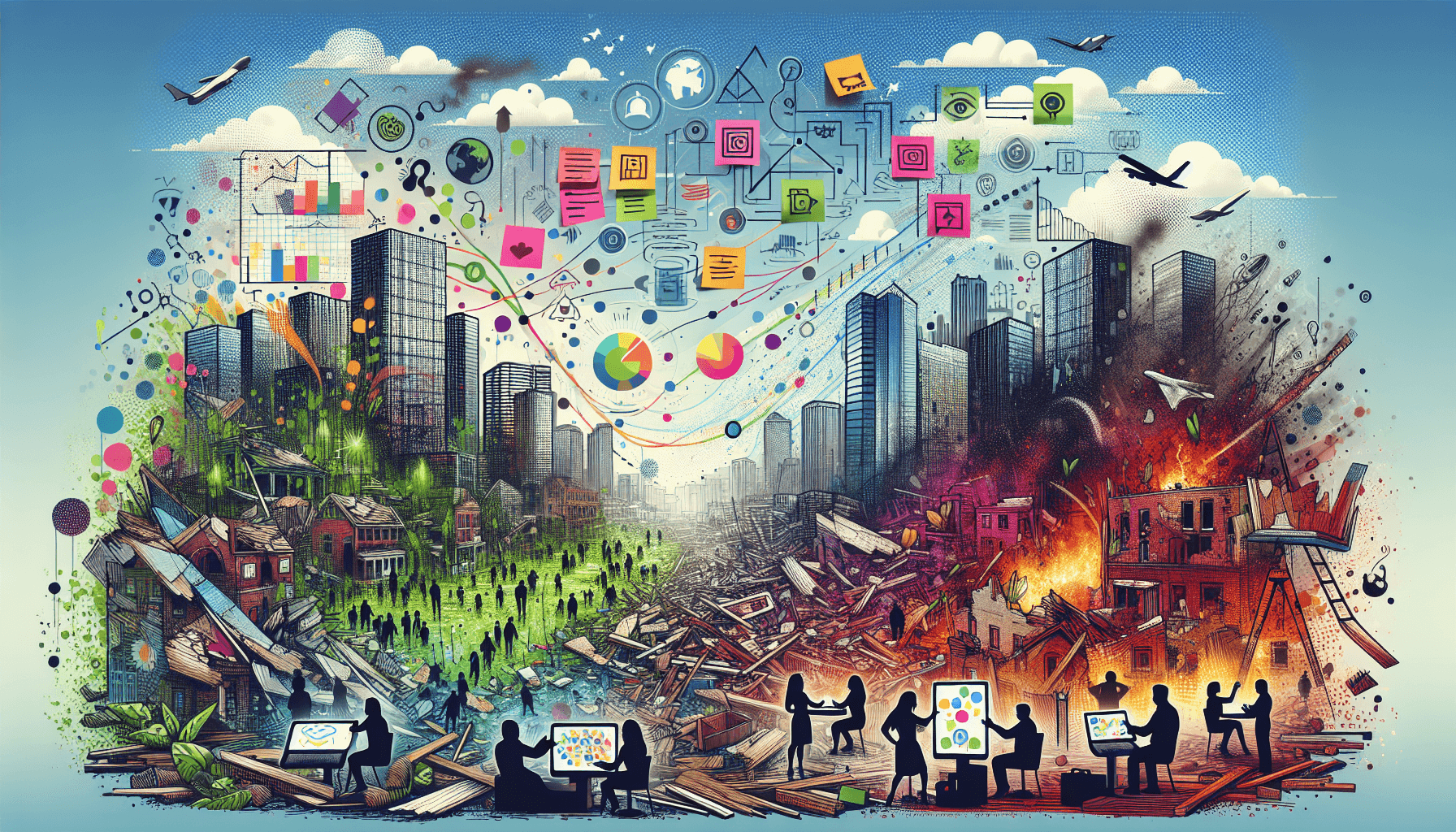
Design Thinking Revolutionizes Disaster Reporting
A systematic approach to enhancing accuracy and empathy in news media
Design Thinking Revolutionizes Disaster Reporting
When the 2015 earthquake struck Nepal, media outlets around the world scrambled to cover the story. Amidst the chaos, a group of journalists and designers saw an opportunity to improve how disasters are reported. Their work, drawing on design thinking methodologies, dramatically changed the narrative and coverage of such events. This approach not only improved the accuracy of the reports but also ensured that the stories were told with empathy and respect for those affected.
The Origins of Design Thinking
Design thinking as a formalized concept emerged in the late 20th century, heavily influenced by companies like IDEO, a global design consultancy. Unlike traditional problem-solving methods that often focus solely on the technical aspects, design thinking emphasizes understanding the human element. Empathy, ideation, and experimentation are its cornerstones.
The process typically involves five stages: empathize, define, ideate, prototype, and test. This human-centered approach allows for more innovative and comprehensive solutions by focusing on real-world user needs.
The Challenge of Disaster Reporting
Traditional disaster reporting often struggles with issues like sensationalism, misinformation, and a lack of sensitivity. Journalists face the dual challenge of quickly disseminating information while being accurate and compassionate. The Nepal earthquake in 2015 highlighted these challenges starkly. Initial reports were rife with inaccuracies, and coverage sometimes lacked sensitivity, further distressing those affected.
Innovating with Design Thinking
Design thinking's introduction to disaster reporting was spearheaded by a collaboration between journalists, designers, and academics. Their goal was simple: to revolutionize how news is gathered, presented, and consumed during disasters.
Empathy and Understanding
The process began with empathy, a key tenet of design thinking. Journalists immersed themselves in the affected communities, not just to gather facts, but to understand the lived experiences of those impacted. This empathetic approach led to reporting that was more nuanced and respectful, capturing the human stories behind the statistics.
Defining the Real Issues
In the define phase, the team analyzed the challenges of disaster reporting. They identified core issues such as the balance between speed and accuracy, and the need to avoid further traumatizing survivors. These insights guided their development of more effective reporting strategies.
Ideating Innovative Solutions
With a well-defined problem, the team moved to ideation. Brainstorming sessions brought together diverse perspectives, leading to innovative solutions. One such idea was the development of a toolkit for journalists that included guidelines on how to report empathetically and accurately during disasters.
Prototyping and Testing
The team then constructed a prototype-an online platform for journalists that integrated the toolkit, offering resources like survivor interviews and mental health guidelines. Testing this platform during subsequent disasters, they gathered feedback from users to refine their approach further.
What Made This Approach Innovative?
Conventional disaster reporting often prioritizes speed over depth, potentially leading to oversights and insensitivity. The design thinking approach innovated by prioritizing human needs and iterative improvement. This methodology allowed journalists to craft stories that did justice to their subjects while maintaining the urgency required during disasters.
Rather than viewing reporting as a linear process, the team saw it as dynamic and responsive. This flexibility allowed them to adapt quickly to changing circumstances and feedback, ensuring continuous improvement.
Transferable Problem-Solving Skills
The principles of design thinking extend beyond disaster reporting. Applying empathy to understand the core needs of stakeholders can enhance any problem-solving process. Moreover, defining the problem with precision ensures that solutions are targeted and effective, avoiding unnecessary distractions.
The iterative nature of prototyping and testing encourages a culture of experimentation and learning. This adaptability is crucial in today's fast-paced world, where challenges and environments constantly evolve.
Practical Takeaways for Readers
- Empathy is Key: Start with understanding the people affected by your problem. This will help you frame the issue more accurately and develop solutions that truly meet their needs.
- Define with Clarity: Clearly articulate the problem you're addressing. This sharpens your focus and guides your ideation process.
- Diverse Perspectives Fuel Innovation: Include varied viewpoints during brainstorming sessions. This diversity leads to more creative solutions.
- Iterate and Evolve: Treat solutions as works in progress. Gather feedback, test your ideas, and refine them continually.
- Human-Centric Approach: Remember that at the heart of most problems are people. Ensure that solutions are designed to improve their experiences.
Design thinking transformed disaster reporting by prioritizing empathy and iterative innovation. These principles, when applied broadly, can enhance problem-solving across industries, leading to more effective and compassionate solutions.
Written by
Kaairo TeamExpert insights on AI-powered problem-solving assessments and innovative hiring practices.
Learn more about us →Related Articles

Innovative Problem Solving Through Open Source Collaboration
Discover how open source collaboration drives innovation worldwide, focusing on systematic approaches and transferable skills.

Frugal Innovation: Ingenious Solutions from Emerging Markets
Explore how frugal innovation in emerging markets offers systematic solutions, exemplified by the Jaipur Foot prosthesis.
Design Thinking in Healthcare: A Global Perspective
Discover how design thinking revolutionizes healthcare with systematic innovation, enhancing delivery and patient outcomes globally.
Ready to Test Your Problem-Solving Skills?
Take the Kaairo daily challenge and discover how you compare to thousands of problem solvers worldwide.
Start Today's Challenge